Definition
Net profit vs revenue vs gross profit vs contribution margin
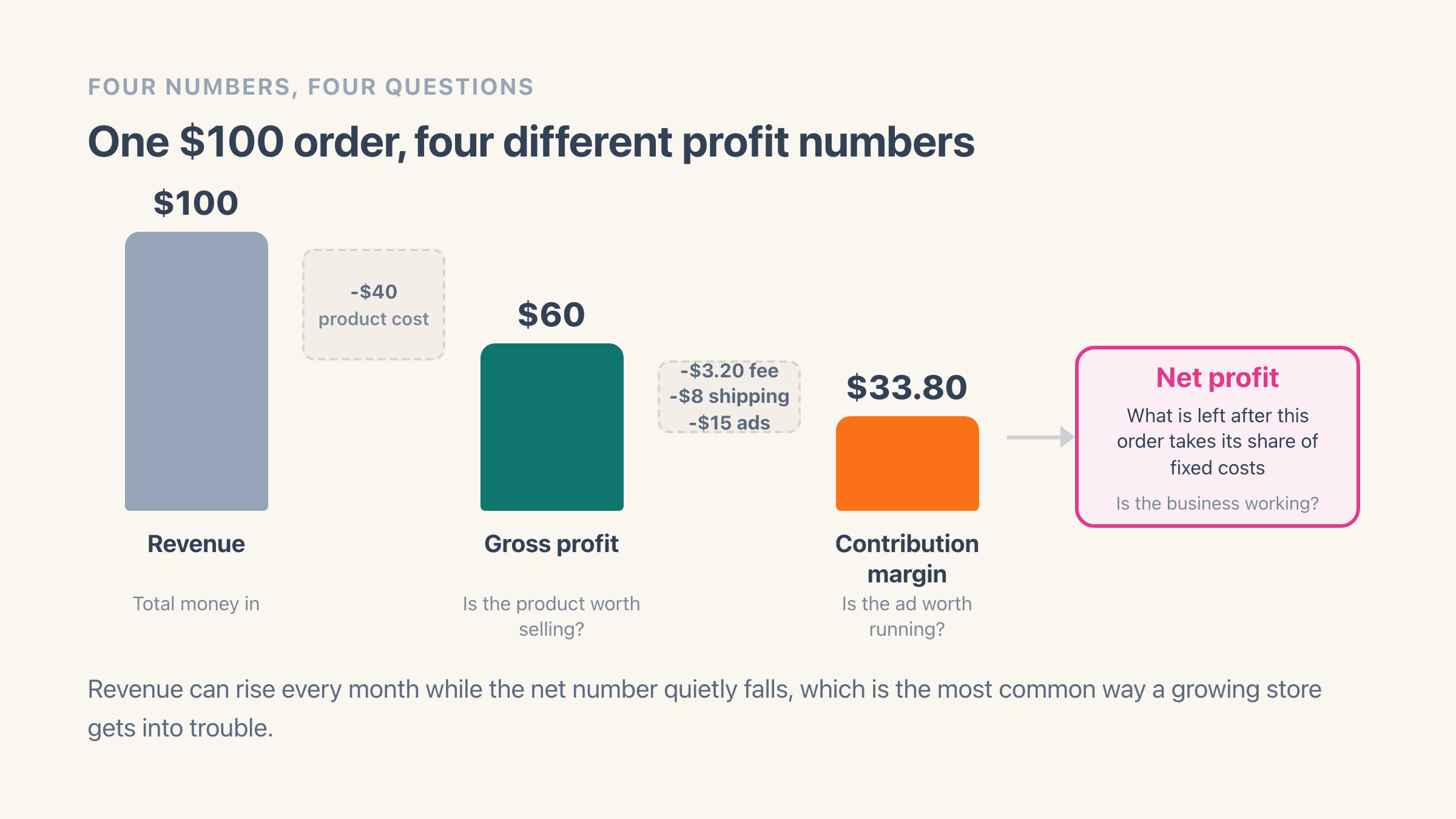
Four numbers get called "profit" in ecommerce conversations, and they answer four different questions. Revenue is the total money that came in from sales. Gross profit is revenue minus the cost of the products you sold, also called cost of goods sold. Contribution margin goes one step further and subtracts every cost that scales with the order, including the ad spend behind it. Net profit subtracts everything, fixed costs included, and is the only one that tells you whether the business made money.
They can tell completely different stories about the same month. A store doing $80,000 in revenue at a 55% gross margin looks healthy until ad spend, shipping, returns, software and salaries come out, at which point it can be flat or negative. This is the single most common way a growing Shopify store gets into trouble: revenue rises every month, so nobody looks harder, and the net number has quietly been falling the whole time.
Use gross margin to decide whether a product is worth selling. Use contribution margin to decide whether an ad is worth running. Use net profit to decide whether the business is working.
What costs do you subtract to get net profit?
Six things come out of the sale: what the goods cost you, the payment fee, the shipping you absorbed, anything that came back, the ad spend behind the order, and that order's share of your fixed costs. Revenue minus all six is net profit. The arithmetic is easy, and the awkward part is that those six numbers live in six different places, a few of which never appear in Shopify at all.
Working from a Shopify order, the costs that come out are:
- Product cost - what you paid your supplier per unit, plus inbound freight and per-unit packaging.
- Payment processing - Shopify Payments takes a percentage plus a fixed amount per transaction, and the rate differs by country, card type and Shopify plan. An external gateway adds a Shopify transaction fee on top.
- Shipping you absorb - the gap between what the customer paid for shipping and what the carrier charged you. Free-shipping thresholds make this the most underestimated line on the list.
- Returns and refunds - the refunded revenue, the return shipping, and the stock you cannot resell. A chargeback is the same loss with a dispute fee on top of it, and when both keep arriving from one buyer it stops being a cost line and becomes someone to stop selling to.
- Ad spend attributed to the order - the share of Google, Meta or TikTok spend behind the sale.
- Fixed costs spread across the period - your Shopify plan, app subscriptions, salaries, rent, accounting.
What Shopify shows you, and what it does not
Shopify reports revenue, gross sales, discounts, returns and taxes well. It does not calculate net profit, and the reason is simple: it does not know most of your costs. Your supplier price lives in your head or a spreadsheet, your real shipping cost lives with the carrier, and your ad spend lives in the ad platforms.
Shopify does store a Cost per item field on each product variant, which powers a gross-margin figure in some reports. That is genuinely useful and worth filling in. It stops at gross margin though, so it will not catch the order that lost money after a discount code, a return and $18 of ad spend.
The gap is why profit apps exist. The useful ones do not just add a number; they tell you which parts of the calculation are measured and which are guessed. See how to calculate net profit on Shopify for the step-by-step version, and how to tell whether your store is profitable for the same question asked of a whole month.
Why does my net profit number look wrong?
Three mistakes account for most profit numbers that turn out to be wrong: tax sitting inside your own prices, one blended margin stretched across the whole catalogue, and returns counted before they land.
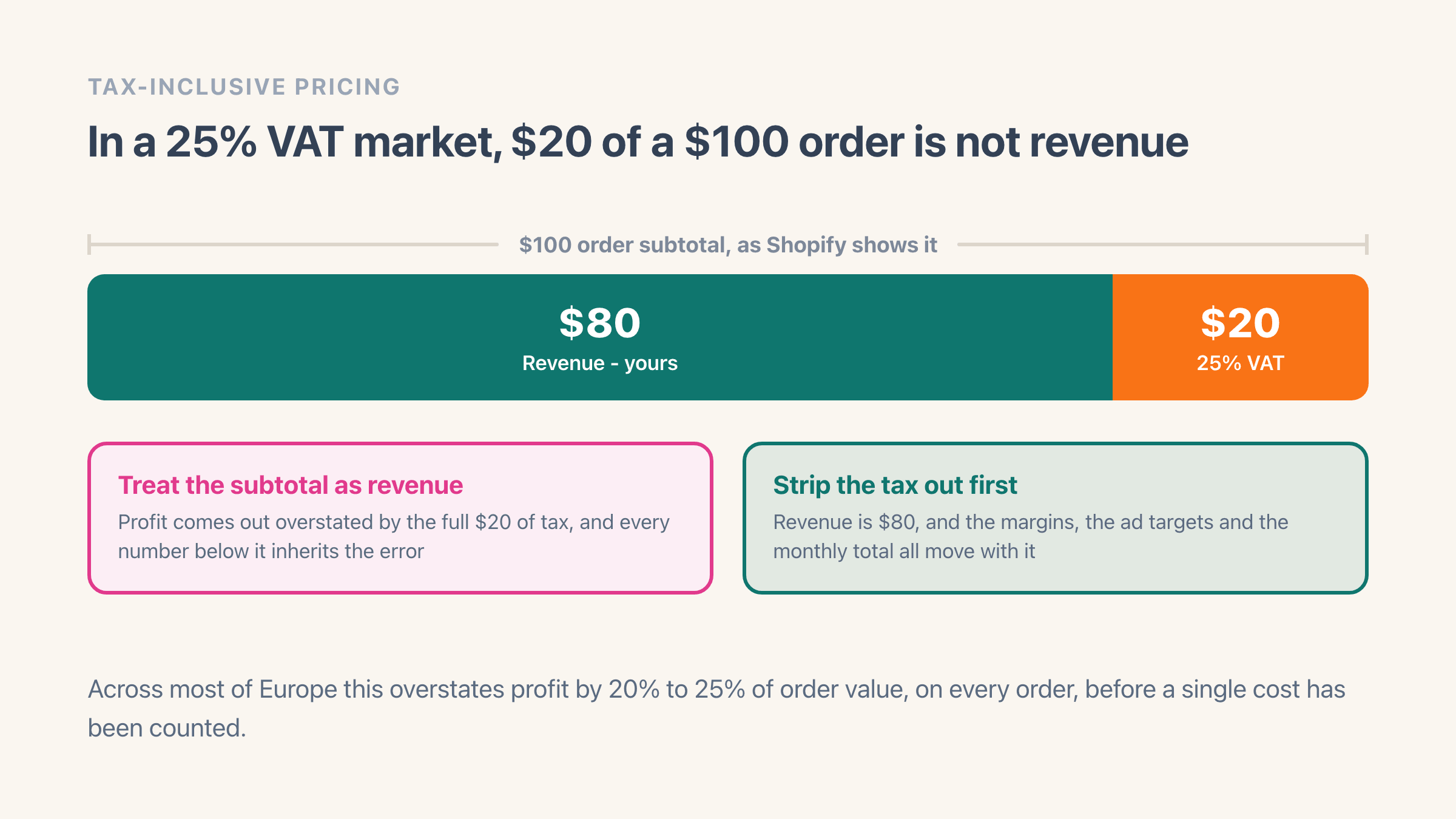
Tax-inclusive pricing is the one that catches European stores hardest. If you sell in a market where prices include VAT, the order subtotal Shopify shows you already contains the tax.
Treat that subtotal as revenue and you overstate profit by the full VAT amount, which across most of Europe means overstating it by 20% to 25% of order value. Any profit calculation for an EU store has to strip tax out first, and plenty of tools quietly get this wrong.
A flat margin assumption is the second. Applying one blended margin across the whole catalogue hides the products that lose money, and real per-product cost almost always turns up a group of SKUs that were never profitable, usually the ones bought at low volume or discounted most often.
Counting returns late is the third. A return can land weeks after the sale, so a month that looked profitable on the 30th can turn once the returns settle. Profit calculated before returns come back is a forecast rather than a result.
Is net profit the same as the cash in your bank account?
No, and the two can disagree for months at a time. Profit and cash move on different clocks: payouts arrive on a delay, stock is paid for long before it sells, and a month with a big inventory purchase can be profitable on paper and painful in the bank. Neither number is the truthful one on its own. Profit tells you whether the model works and cash tells you whether you can pay for things this week.
Check profit monthly to see whether the business is sound, and check the bank weekly so a good month on paper does not walk you into a shortfall. Most of the gap between them is sitting on your shelves, so it helps to know what your stock is worth at cost rather than guessing at it.
What counts as a good net margin
There is no universal benchmark, and anyone quoting one without naming the product category is guessing. Net margin depends on what you sell, how much of your demand is paid, and how often things come back. A low-return, low-ad-dependence brand behaves nothing like a fashion store running paid social.
What matters more than the number is the pattern. Look for a net margin that stays positive after every cost including ads, and that holds or improves as revenue grows. A margin that shrinks while revenue rises means growth is being bought rather than earned, and it is the earliest warning sign in the whole set. The line each campaign has to clear before it pays for itself comes straight out of that margin, and break-even ROAS is where the arithmetic lives.
Example
A $100 order with $40 product cost, a $3.20 payment fee, $8 shipping you absorbed and $15 of attributed ad spend: revenue is $100, gross profit is $60, contribution margin is about $33.80, and net profit is whatever remains after that order takes its share of fixed costs. Run the same order in a VAT-inclusive market at 25% and revenue is actually $80, which moves every number below it.
Commonly confused with
- Gross profit
- Gross profit stops after the cost of the goods. Net profit keeps going through payment fees, shipping, returns, ad spend and the monthly bills.
- Contribution margin
- Contribution margin takes out every cost one order causes, ad spend included, and leaves the fixed costs alone. Net profit takes those out too, which is why it only means anything across a period.
- Cash in the bank
- Profit says whether the model works. Your bank balance says whether you can pay for things this week, and payout delays plus stock bought months early keep the two apart.