Definition
What happens when a customer files a chargeback?
The customer goes to their bank instead of to you, so the first you hear about it is the notice in your admin. From that moment it runs on a clock nobody in your store controls.
- The money leaves first. With Shopify Payments the disputed amount and the chargeback fee come out of your next payout straight away, before anyone has read a word of evidence.
- You get a deadline. Shopify puts the usual window at 7 to 21 days, depending on the card network and the reason given.
- You choose one of three things: send evidence, accept the dispute, or do nothing. Doing nothing is a choice with a result, because Shopify submits the basic order information on your behalf when the deadline arrives.
- The card company reviews it, which Shopify says can take up to 75 days after you submit.
- The decision is final. There is no appeal and no sending more evidence afterwards.
What does a chargeback actually cost?
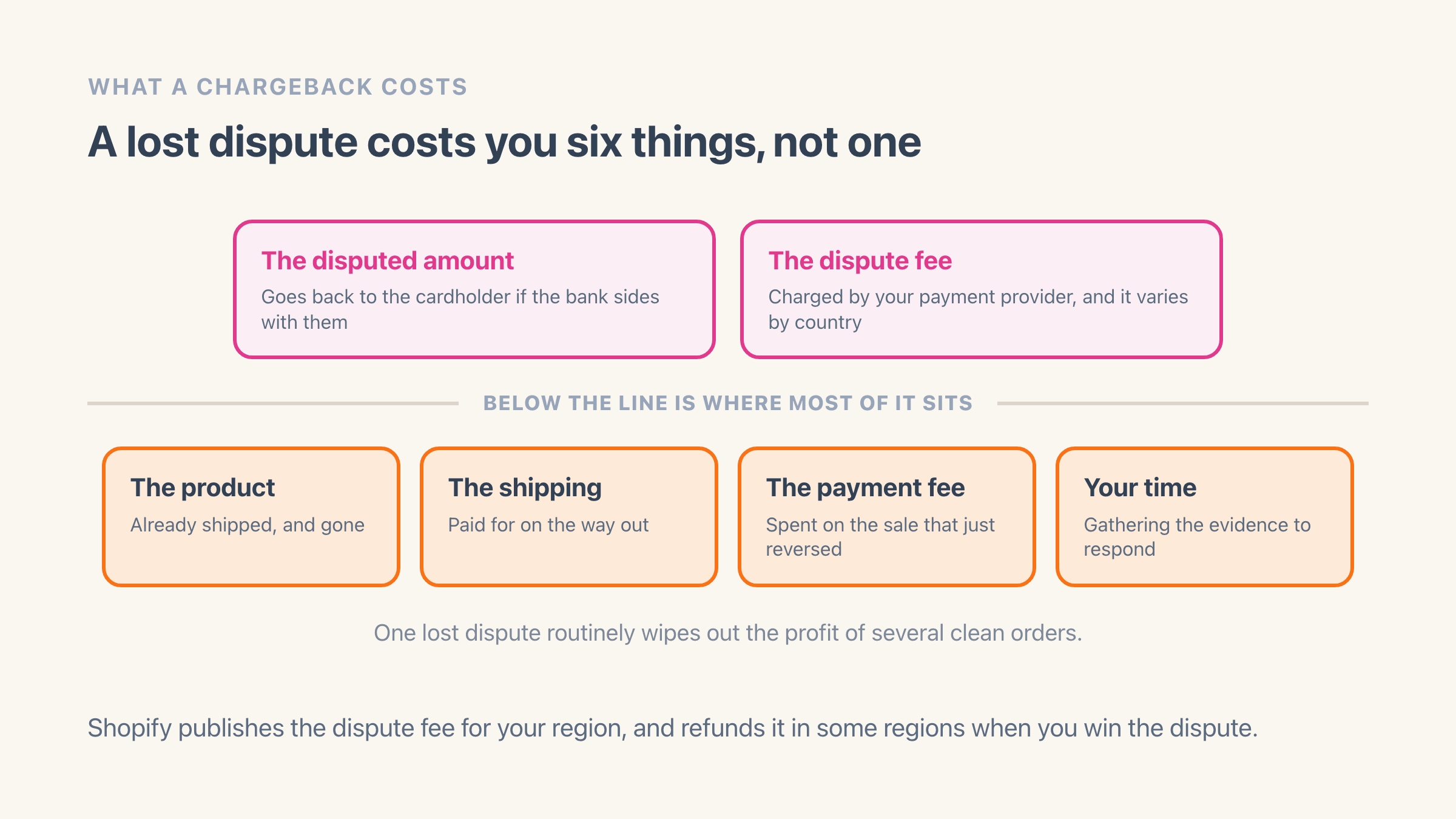
The visible cost is the reversal: the order amount goes back to the cardholder if the bank sides with them. On top of that sits a dispute fee charged by the payment provider, which varies by country - Shopify publishes the amounts for your region in its chargeback documentation.
The invisible costs are usually bigger: the product is gone, the shipping was paid, the payment fee from the original sale is spent, and the time to gather evidence is yours. A single lost dispute routinely wipes out the profit of several clean orders, which is why the per-order damage belongs in your profit numbers rather than in a separate mental bucket.
Put your own margin against it and the size lands properly. On a $90 order at a 30% net margin you keep $27, so one lost dispute at that value takes back the $90, the goods and the fee, and you need roughly four more clean orders to stand still. Two of those in a slow month is a real hole.
Inquiry vs chargeback
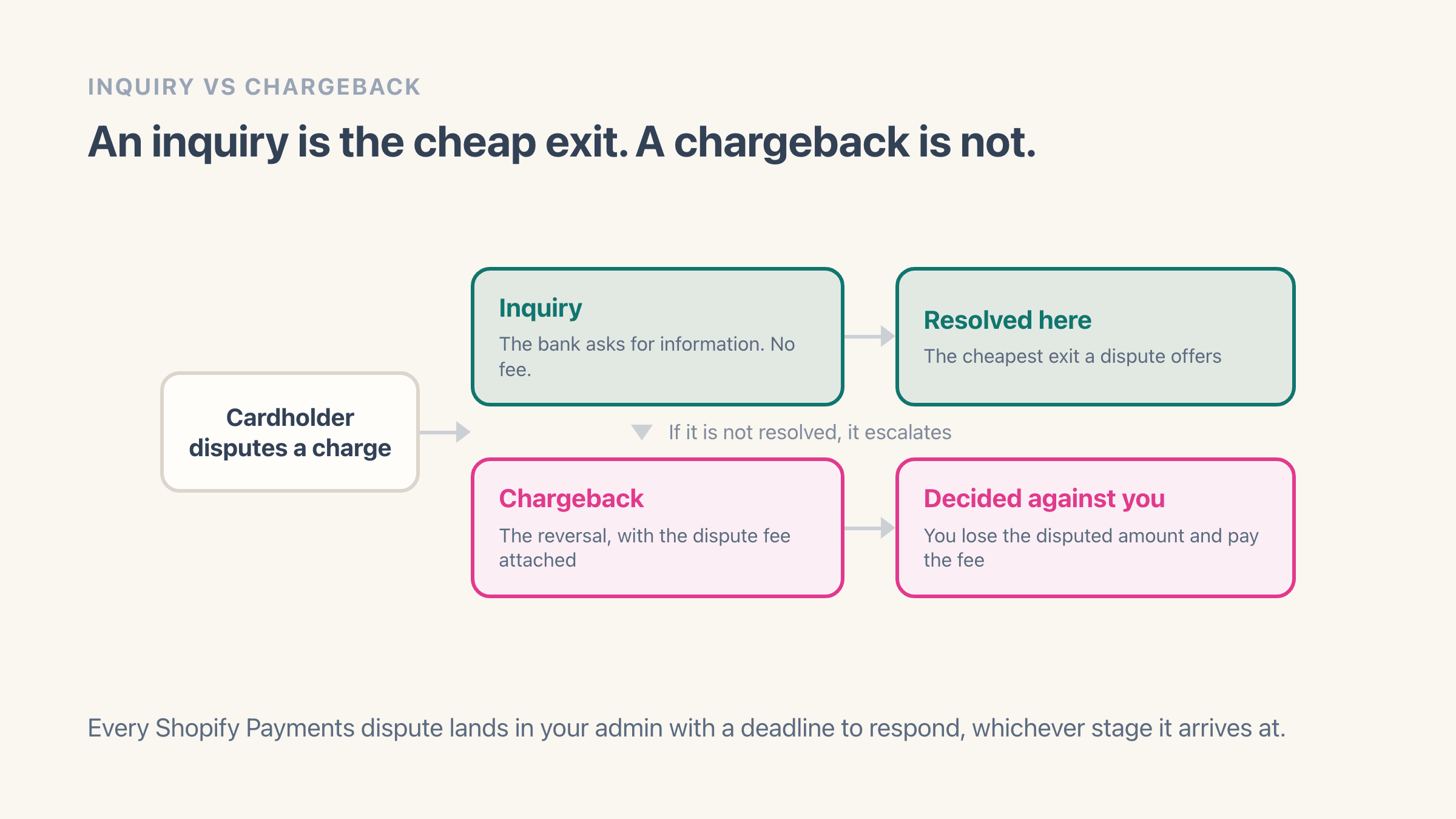
Not every dispute starts as a full chargeback. An inquiry (or retrieval request) is the bank asking for information before deciding whether to escalate, and it carries no fee. A chargeback is the actual reversal with the fee attached. Responding well at the inquiry stage is the cheapest exit a dispute offers.
Easy Profit Calculator's chargebacks report lists each Shopify Payments dispute with its type, status, reason, disputed amount and what it cost you, plus how many are still open and waiting on a response. Each dispute's cost lands on the order it hit, so the order's profit tells the true story.
What evidence wins a chargeback?
Evidence that answers the exact reason the bank gave, with a document behind it. Shopify Payments fills part of the response in for you: the products and quantities, the carrier and tracking number, when the order was placed and when it was fulfilled, the shipping and billing addresses, and where the customer was when they ordered. On item-not-received disputes it also adds a written summary supporting your case unless you turn that off.
What you add on top decides most cases:
- Delivery confirmation to the address on the order, with a signature where you can get one. For "never arrived" this is the strongest thing you have, and for an event the equivalent proof is the check-in scan showing the ticket was used at the door.
- The customer's own messages. An email saying the parcel came, or asking how to return it, ends the argument faster than any policy page.
- Proof the customer saw your terms. A refund window shown at checkout carries more weight than the same words on a policy page nobody visited.
- Photos, serial numbers, or the personalisation record when the claim is that the item was not as described.
Is it worth fighting a chargeback?
Not always, and deciding quickly matters more than deciding perfectly. Weigh three things: the amount, whether you can prove delivery to the address on the order, and how long the paperwork will take you.
Accepting is never free. The disputed amount goes back to the customer and the fee has already been taken out of your payout, so accepting is only ever the cheaper option, never a costless one. Shopify refunds the chargeback fee in some countries when you win, which changes the sums on the mid-sized ones, so check what applies where you sell before you write off a whole band as not worth defending.
One rule holds up in practice. Defend anything where delivery to the order address is provable, accept the small ones where it is not, and never let a deadline pass by accident. A long explanation with no document attached loses. Restating your policy, or arguing that the customer must be lying, loses too. Answer the reason on the notice, attach the proof, stop.
How do you reduce chargebacks?
Most disputes are not clever fraud. They are people who did not recognise a charge, did not get a parcel when they expected it, or could not get an answer out of you and went to the bank instead. Shopify's own prevention advice reads the same way, and it is mostly shop-keeping.
The most preventable one of all never reaches this list, because it starts as a parcel you were never able to send. An order you took for stock you did not have is overselling, and it arrives here weeks later as a payment you cannot defend, since you genuinely did not ship the thing.
- Set the wording that appears on the card statement to your store name or your domain. A charge nobody recognises is the most preventable dispute there is.
- Send a receipt when payment is taken and tracking when the parcel ships, then keep the customer updated until it arrives.
- Reply fast and keep your contact details easy to find. A refund granted in an hour costs less than a dispute won in ten weeks.
- Look at the orders Shopify flags as high risk before you fulfil them. Cancelling one is cheaper than defending it.
- On US, UK and Canadian orders, consider shipping only when the billing address check passes, and contacting the customer first when it does not.
- Refund an accidental double charge the moment you spot it and tell the customer you have.
- Cancel a subscription the day it is asked for, confirm it in writing, and say plainly on the signup page what will be charged and when.
What if the customer really did order it?
This happens often enough to have its own name: friendly fraud. Someone forgets a purchase, a partner or a teenager used the card, or the name on the statement looks nothing like the shop they bought from. The order is genuine, nobody set out to rob you, and the dispute still costs you the same money.
Start with the customer rather than the paperwork. Shopify's guidance says the same thing: get in touch, and if the two of you sort it out, they can go back to their bank and withdraw the dispute. That call is worth making on day one, before you spend an hour assembling evidence for an argument that did not need to happen.
Where the same customer does it more than once, stop selling to them. Evidence does not fix a pattern, and the second dispute costs exactly what the first one did. However many orders they have placed, their lifetime value measured in profit is negative.
Where it lives in your Shopify admin
Orders > open the disputed order, where the chargeback banner carries the respond-by date and an Add evidence button that opens the chargeback response page. The disputed amount and the fee come out of your next payout, which you can see under Finances > Payouts.
Commonly confused with
- Refund
- A refund is you sending the money back. A chargeback is the customer's bank taking it, and adding a dispute fee you pay whichever way the case goes.
- Inquiry, or retrieval request
- An inquiry is the bank asking for information before it decides anything, and it carries no fee. A chargeback is the reversal itself, with the fee attached.
- Friendly fraud
- Friendly fraud is a dispute on an order the customer really did place, usually because nobody recognised the charge. The order is genuine and it still costs you the same money.