Definition
Gross margin vs net margin
Gross margin is revenue minus cost of goods sold, as a percentage. It tells you whether the products themselves have room to make money. Net margin takes out everything else too - payment fees, shipping you absorb, returns, ad spend and fixed costs - and tells you whether the business makes money.
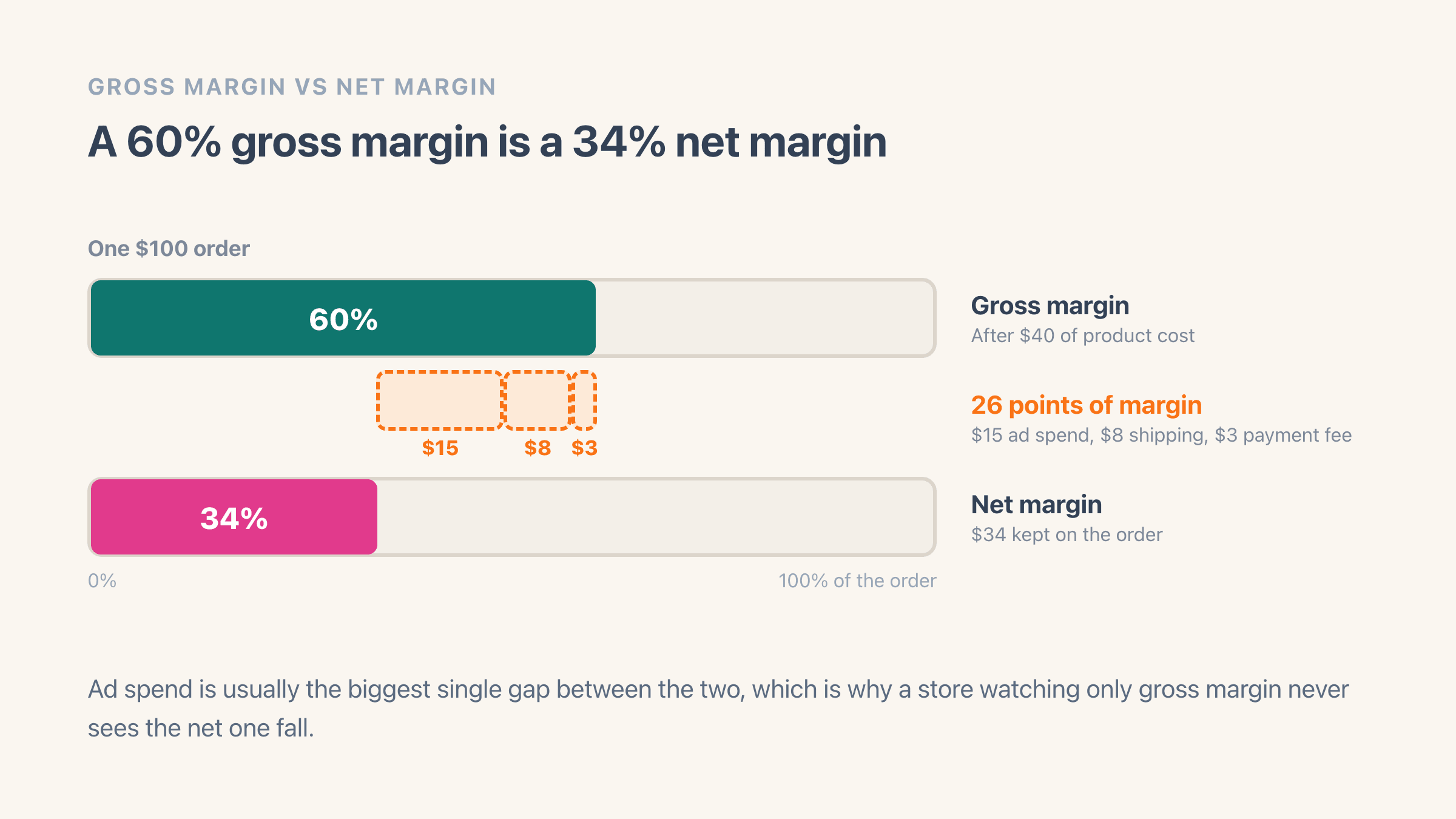
The gap between the two is where stores get surprised. A 60% gross margin can shrink to a single-digit net margin once ads and shipping are counted, and the store owner watching gross margin never sees it happen.
There is a third one in between that gets less attention and earns its place. Contribution margin takes out everything an order carries, ad spend included, but stops before the fixed bills. It is the share of each extra sale left over to pay for the parts of the business that do not scale.
Which margin should you watch every month?
Net margin monthly, contribution margin per decision. A month is the shortest period where net margin means anything, because rent, salaries and your app bills arrive monthly rather than per order, and because last month's returns need time to land before the number settles.
Contribution margin is the one to open before you change something. Whether a product earns its shelf space, whether a campaign can pay for itself, whether the free-shipping threshold is set too low - all of those are answered by what a single extra order leaves behind, and none of them wait for the month to end.
Gross margin has one job, which is telling you whether a product has room to work at all. It also happens to be the only margin Shopify can show you, so it gets watched by default rather than on merit. It is the number that moves least, which makes it comfortable and slightly useless.
What is a good profit margin for a Shopify store?
There is no universal number, and be suspicious of anyone quoting one. Margin depends on what you sell and how you sell it: digital products carry almost no product cost, dropshipping stacks thin margins against paid traffic, and own-brand physical products sit in between, with ad spend usually the deciding cost.
Published industry tables are the closest thing to an outside benchmark, and they need reading with care. NYU Stern's 2026 industry figures put net margin for general retail near 5.6%, apparel around 3.9%, grocery and food a shade over 1%, and household products up near 11.7%. Those are listed companies with scale, buying power and warehouses of their own. A small store selling apparel on paid social should not read 3.9% as a floor it has already cleared.
What counts as healthy depends on the model more than the category:
- Own-brand physical products. The gross margin is usually there. Ad spend decides how much of it survives.
- Dropshipping. Thin product margin against bought traffic, so the ad number is the business.
- Digital or made-to-order. Almost no product cost, so fixed costs and refunds set the margin.
- Subscriptions and consumables. The first order can lose money if the second and third are dependable, which only holds once you can point at your own customer lifetime value.
What costs get left out of a profit margin?
Five costs go missing more often than the rest, and every one of them makes the margin read better than it is.
- Payment fees. A percentage plus a fixed amount on every order, and the fixed part bites hardest on small baskets.
- Shipping you absorb. The gap between what the customer paid for delivery and what the carrier billed you. Free-shipping thresholds are the usual reason it grows.
- Returns. The refunded sale, the return postage, the handling, and the item you cannot sell again at full price. A chargeback is the same loss with a dispute fee bolted on.
- Discounts. A code comes off the price but is paid for out of margin.
- Fixed costs. Your Shopify plan, apps, salaries, rent and the accountant, none of which ever appear on an order.
Does VAT belong in your revenue when you calculate margin?
No, and getting this wrong overstates every margin in the store. If you sell at tax-inclusive prices, as is normal across the EU, the subtotal Shopify shows you already contains VAT, and that VAT belongs to the tax office rather than to you.
On a 125 euro order in a 25% VAT market, 25 euro is tax and your revenue is 100 euro. Work the margin out on 125 and it reads about a fifth better than reality, on every order, before a single cost has been counted. Your costs, meanwhile, are quoted without tax, so nothing cancels out. Strip the tax from revenue first, then divide.
This is the single most common reason a European store's spreadsheet disagrees with its accountant. It is also why a profit tool that was built for US stores can be quietly wrong for yours.
How do discounts and returns change your margin?
Both come out of the margin rather than the revenue, which is why they move the number further than people expect. A $100 order with $50 of product cost carries a 50% gross margin, so you keep $50. Apply a 20% code and the customer pays $80, your cost is still $50, and you keep $30. Revenue fell by a fifth. Profit fell by two fifths.
The thinner the product, the worse the arithmetic gets. On a 30% margin item, that same 20% code takes two thirds of the profit, and a 30% code takes all of it. This is why a store can run a promotion, see revenue climb, and end the month behind.
Returns behave the same way with a delay attached. The refunded sale takes its costs with it and adds new ones - return postage, the time to inspect and restock, and the item that comes back marked and sells at a discount or not at all. A month that looks fine on the 30th softens once the returns settle, so it is worth reading margin against the period the returns landed in rather than the period the sales did.
How do you calculate your profit margin?
Net margin is net profit divided by revenue, times 100. Gross margin is gross profit divided by revenue, times 100. The arithmetic takes a second. The work is collecting costs that are real, because one missing payment fee or one uncounted return quietly adds a few points.
Do it per order first, then per month. Per order is what tells you which products and which discount codes are worth keeping. Per month is the only level where fixed costs, salaries and the ad spend that never got tied to an order can honestly be included.
You can test scenarios in the free profit margin calculator, which also hands back the break-even ROAS that margin implies, and see your store's actual measured margin, per order and per month, in Easy Profit Calculator.
Where do you find your margin in the Shopify admin?
Shopify holds some of the inputs and none of the answer. Product cost goes in the Cost per item box on each variant, on the product page in your admin, and once it is filled in Shopify can show a gross margin in its own reports. Your payment fees appear on your payouts. Discounts and returns sit on the orders themselves.
What is missing is everything after that: what the carrier actually charged you, what a return cost to take back, what you spent on ads to win the sale, and the monthly bills that never touch an order. Those live with your carrier, in your ad accounts and in your bank. Until they sit alongside the orders, the only margin you can read inside Shopify is the gross one.
Example
A $100 order: $40 product cost gives a 60% gross margin. Take out a $3 payment fee, $8 shipping and $15 ad spend and net profit is $34 - a 34% net margin on that order.
Where it lives in your Shopify admin
Analytics > Reports gets you a gross margin once Products > open a product > Pricing > Cost per item is filled in. The rest of the inputs are scattered: payment fees on each payout under Finances > Payouts, discounts and returns on the orders themselves, and carrier costs, ad spend and monthly bills nowhere in Shopify at all.
Commonly confused with
- Markup
- Markup measures profit against what the item cost you. Margin measures it against what the customer paid, so a 50% markup is a 33% margin on the same product.
- Gross margin
- Gross margin subtracts only the product cost, and it is the one Shopify can show you. Net margin subtracts everything, with ad spend usually the biggest gap between the two.
- Contribution margin
- Contribution margin sits between the two. It takes out every cost one order causes, ad spend included, and stops before the bills that would have arrived anyway.