Short answer
How do you check whether the store is profitable?
Stop reading revenue, start reading net profit
Sales totals tell you almost nothing about profit. A $50,000 month can net $8,000 or lose money, depending on margins and ad spend. Net profit after every cost is the only number that answers the question.
If it does not work
You read the profit figure in Shopify's own reports and take it for the answer. That number is gross profit, which stops after the cost of the goods and before fees, shipping, returns, ads and overhead, so it can be double what you actually keep.
Get every cost into one place
Product costs, payment fees, shipping you absorb, returns, ad spend, and fixed costs like apps and salaries. Missing even one category quietly inflates the answer, and it is usually the missing one that hurts.
If it does not work
The number comes out comfortable because a whole category is missing rather than zero. Variants with no cost set count as free, and a store that never entered its ad spend or its monthly overhead gets a profit figure that looks fine right up until the bank balance disagrees.
How to undo it
Fixed costs and salaries are ongoing settings rather than a one-way import, so correcting or removing one changes the period totals it feeds.
Look at profit per order, not just the total
Profitable stores still lose money on individual orders: heavy discounts, free shipping on a low-value cart, a card fee on a tiny order. A negative-profit orders report shows exactly which sales cost you money.
If it does not work
A healthy monthly total hides a category that loses money on every sale. If you only ever read the total, the orders underwater stay invisible, and they are usually concentrated in one product, one discount code or one shipping rule.
Judge a full month, then compare
One good week proves nothing. Read a complete month with fixed costs spread across it, then compare against the previous period to see whether the store is trending toward or away from profit.
If it does not work
You call it on a strong fortnight and the refunds land afterwards. Returns often settle two or three weeks behind the sale, so a part-month read flatters you, and dividing fixed costs into a short window makes every order look better than it was.
Why do most Shopify stores fail?
Rarely because the idea was bad. Far more often the owner poured money into something that was quietly unprofitable and could not see it - an ad campaign with a healthy return on ad spend measured against revenue and a loss once costs were counted, or a hero product with a margin thinner than its return rate.
I run stores doing more than $5M a year on Shopify, and I built this app because I had the same blind spot. Sales came in, the graph went up, and the bank balance disagreed. Shopify's own reports stop at sales, so the costs that decide whether you keep any of it sit in six different places and nobody adds them up.
The people asking this question on Reddit get two kinds of answers: screenshots from dropshipping gurus, and bitterness from stores that failed. Both are honest, neither helps you. The dull version from inside a working store is that the money is real and it has almost nothing to do with the revenue number.
Where the money quietly leaks
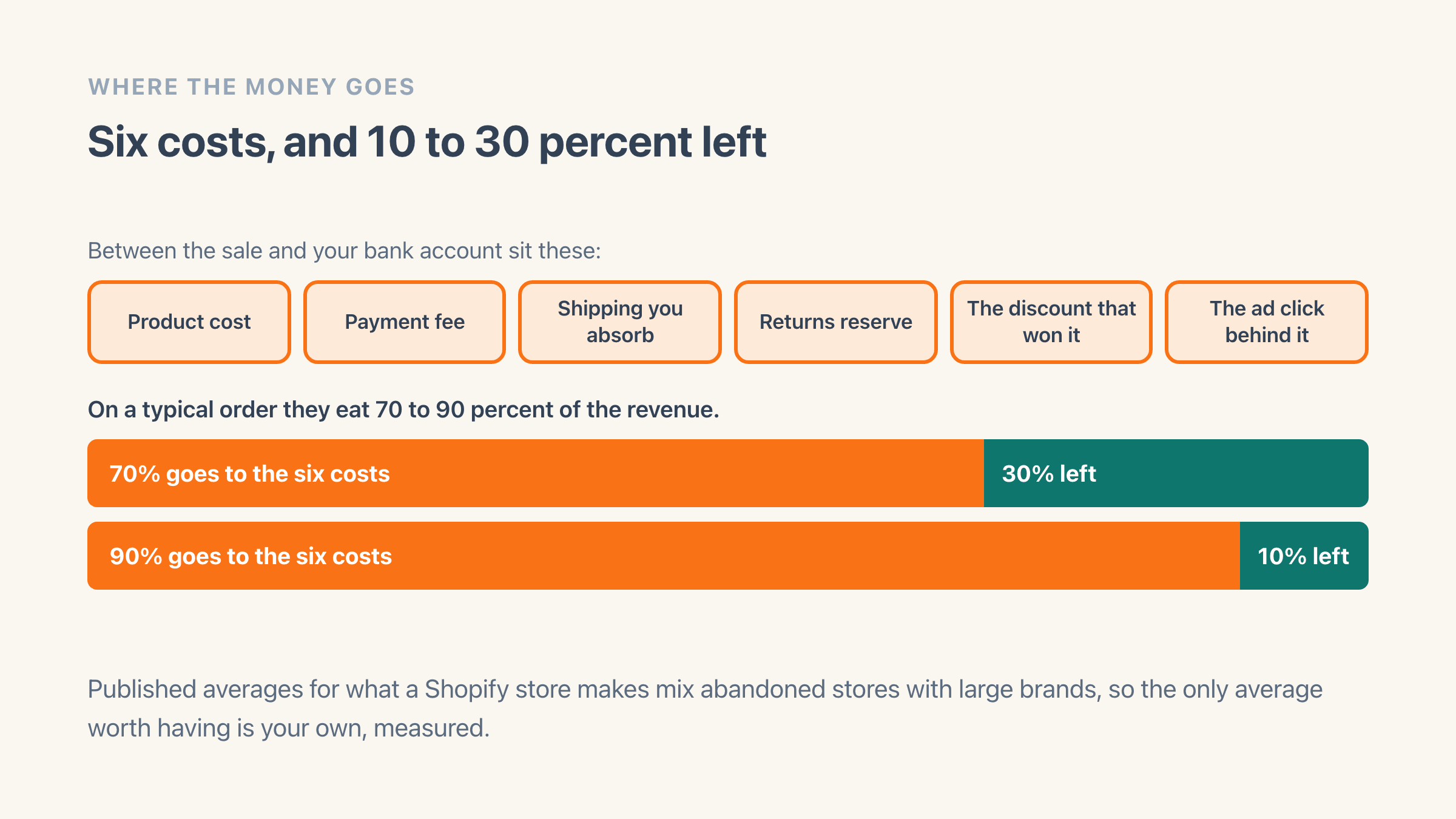
Between a sale and your bank account sit five or six costs, and each one looks small alone: the product cost, the payment fee, the shipping you absorb on free-shipping orders, the money you hold back for returns, the discount that won the order, and the ad click behind it. On a typical order they can eat 70 to 90 percent of the revenue.
A handful of buyers can widen the returns line on their own, and that one has a different fix from the rest of the list - a rule at checkout rather than a better margin. Shopify puts a risk label on card orders the day they arrive, and what that label is predicting is worth knowing before one of them turns into a dispute.
Sell abroad and a seventh joins them, off nobody's list because it lands after the parcel does: duty billed to your customer at the door on an estimate Shopify built from a blank field. That one is fixed once, in a spreadsheet, and then it stops happening.
That is why "how much does the average Shopify store make" has no useful answer. Published averages mix hobby stores with eight-figure brands, and none of them know your margin. The only average that matters is your own, measured.
Does Shopify's sales total include VAT?
On a tax-inclusive store it does, and that single fact makes a lot of European stores look healthier than they are. If your prices already contain VAT, the sales figure Shopify shows you still has the tax office's share sitting inside it, while your product costs and shipping bills are quoted without tax. Revenue reads high, costs read normal, and margin comes out flattering.
The size of it is not subtle. On a 25% rate, a month that shows 100,000 in sales is really 80,000 of your money. Work out a margin against the bigger figure and you can be twelve or fourteen points off - comfortable enough to keep spending on a campaign that is actually losing.
Easy Profit Calculator strips the tax out of revenue by default when your store sells tax-inclusive, taking the rate from each order's own tax lines rather than assuming one national rate, so a store selling into several VAT countries still comes out right. Tax-exclusive stores are left alone, because there the tax was added on top and was never in the sales figure to begin with.
How long does it take a Shopify store to become profitable?
Long enough for the monthly costs to be covered by the profit each order leaves behind, which is arithmetic rather than a season. Work out what a typical order nets you after product cost, fees and shipping, add up what the store costs you every month whether you sell or not, and divide. A store netting $12 an order with $2,400 of monthly costs needs 200 orders a month before it starts keeping anything.
That sum is worth doing on day one, because it tells you which lever to pull. If the number of orders you need is out of reach, more traffic will not save you - the per-order profit is too thin, and the fix is pricing, product cost or shipping. If it is close, the fix really is volume.
Cash is the other half of this, and it moves separately from profit. A profitable month can still leave you short if the money went into stock, which is why what your inventory is worth is worth reading next to your profit figure rather than instead of it.
Watch it monthly rather than weekly. One strong week proves nothing when a return can land three weeks after the sale, and fixed costs only make sense spread across a full month. Comparing this month against the last one is what tells you whether the store is walking toward profit or away from it.
What "profitable" looks like when you can finally see it
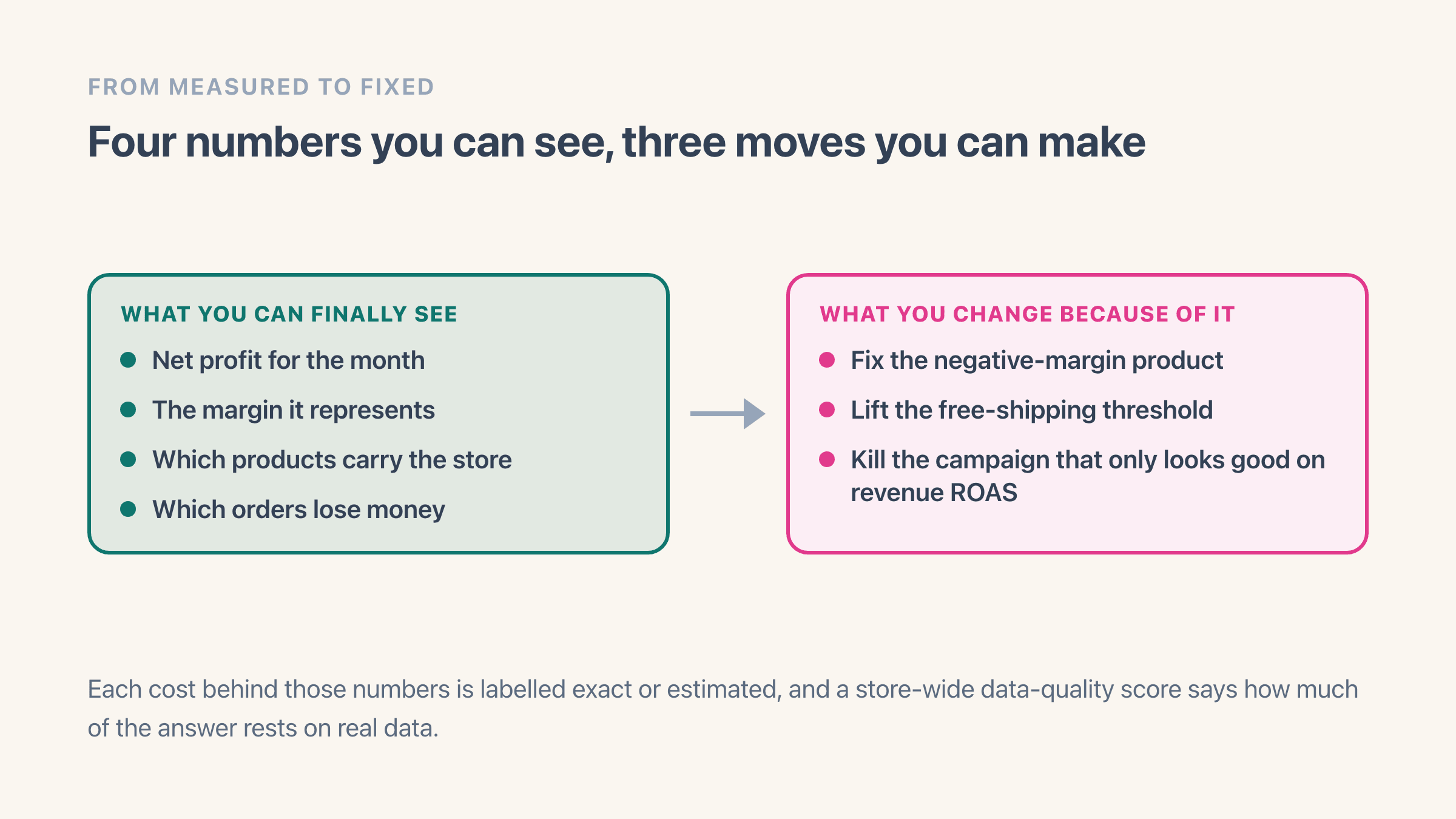
Once every cost is counted, profitability stops being a feeling. You see net profit for the month, the margin it represents, which products carry the store, and which orders lose money. From there the moves are concrete: fix the negative-margin product, lift the free-shipping threshold, kill the campaign that only looks good on revenue ROAS.
Easy Profit Calculator does this per order with every cost labelled exact or estimated, and its data-quality score tells you when the answer can be trusted. The free plan covers 100 orders a month, which is enough to answer the question for most stores that are asking it.