Short answer
How they compare
| Feature | TrueProfitFrom $35/mo | BeProfitFrom $49/mo | This appEasy Profit CalculatorFree, then $19/mo |
|---|---|---|---|
| App Store rating | 5.0 (798 reviews) | 4.3 (172 reviews) | New |
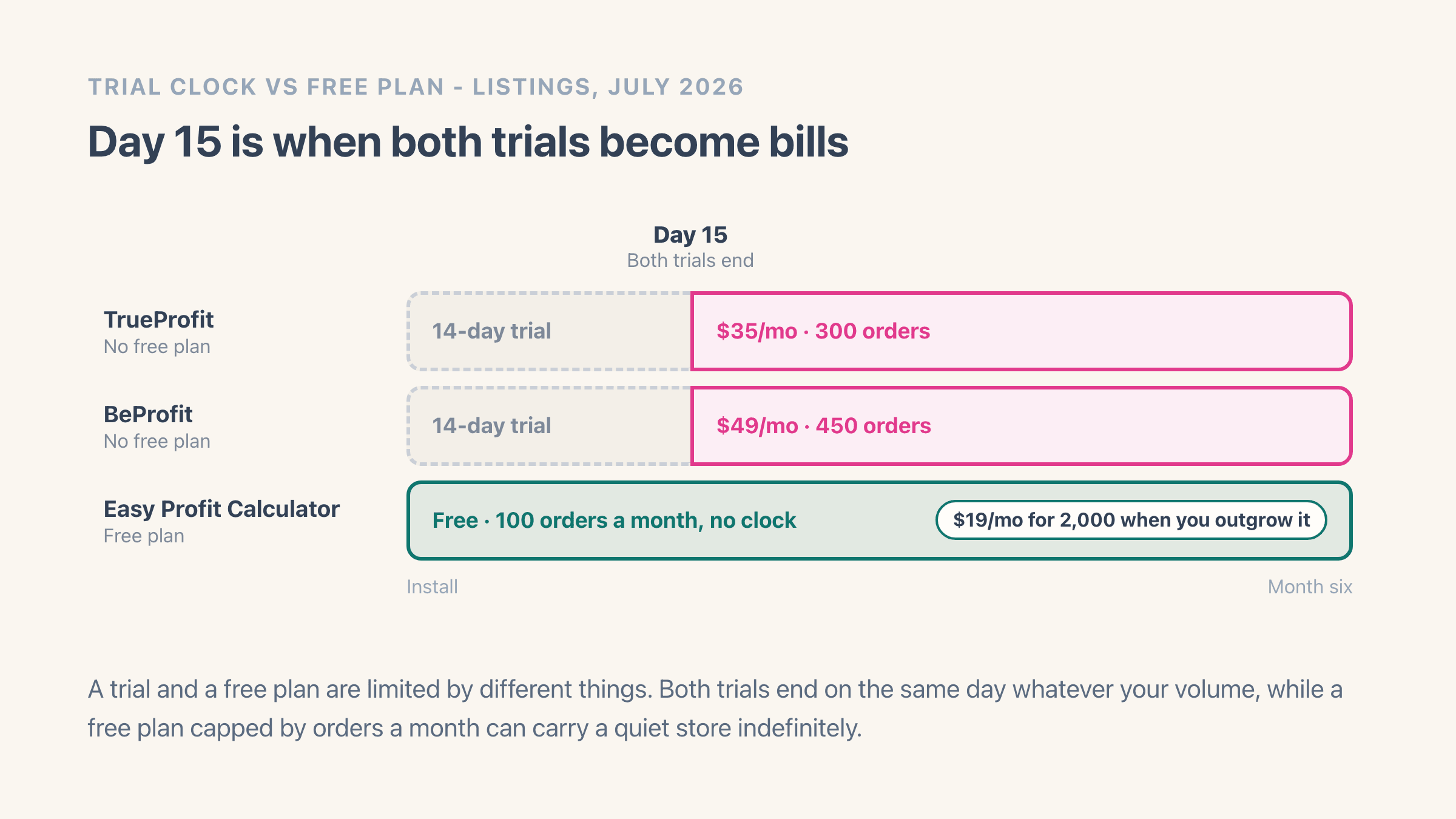
| Genuine free plan | No - 14-day trial | No - 14-day trial | Yes - 100 orders/mo |
| Entry plan | $35/mo (300 orders) | $49/mo (450 orders) | $19/mo (2,000 orders) |
| Going over the cap | $0.30 per extra order on Basic | Next tier ($99/mo) | Soft cap - a nudge, no fees |
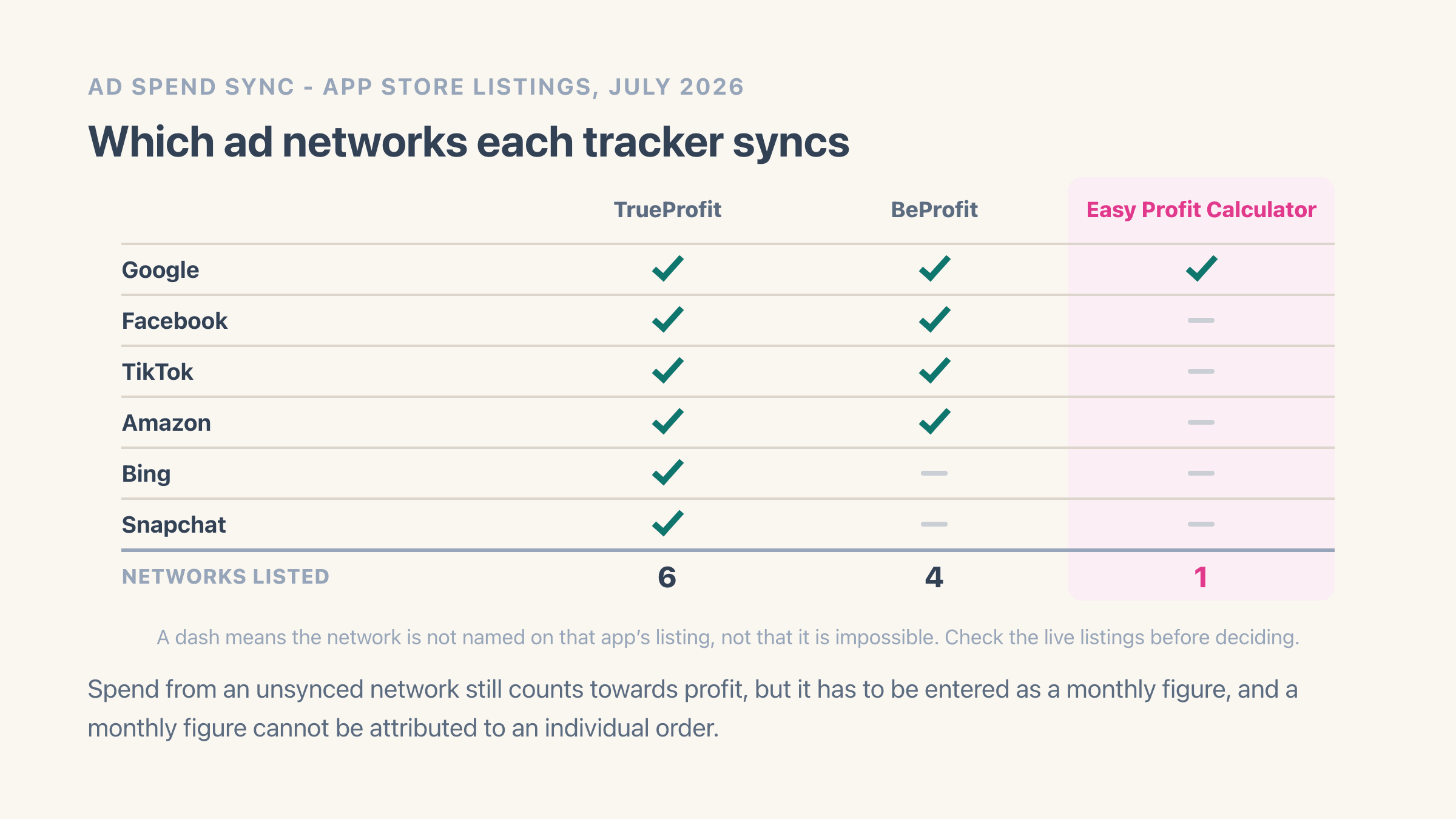
| Ad networks synced | Facebook, Google, TikTok, Bing, Snapchat, Amazon | Facebook, Google, TikTok, Amazon | Google Ads |
| Multi-store / multichannel rollup | Not its focus | Yes - its core strength | No - single Shopify store |
| Mobile app | iOS and Android | Not listed | No |
| Labels each cost exact vs estimated | Not listed | Not listed | Yes |
Where TrueProfit wins
TrueProfit is the category's reputation leader: 5.0 from 798 reviews, on the App Store since 2019, with the widest ad-spend sync of any profit tracker - Facebook, Google, TikTok, Bing, Snapchat and Amazon - plus native iOS and Android apps. For a single brand spending across several ad networks, it is the most automated option.
The cost side is the thing to model before committing: the $35 Basic tier covers 300 orders and then charges $0.30 per extra order, with $60, $100 and $200 tiers above it. A growing store climbs that ladder fast (pricing from its listing, July 2026).
Where BeProfit wins
BeProfit is built for consolidation. If you run several stores, or Shopify plus marketplaces, it rolls profit into one view, adds LTV and cohort analysis, UTM attribution and pricing simulators, and its top plan covers unlimited shops. That multichannel focus is what none of the single-store tools match.
It is also the pricier entry: $49 a month for 450 orders, rising through $99 and $149 tiers to $249 for unlimited (listing pricing, July 2026), with a 4.3 rating from about 170 reviews. In recent one-star reviews, the recurring themes are billing friction and totals not matching Shopify - worth reading yourself before committing.
Can you track Shopify profit without paying for either?
Yes, while your volume is small. Both of these apps assume you will pay from day 15, and if your store does under 100 orders a month, or you simply want to live with a profit tool before spending anything, Easy Profit Calculator starts free, covers 2,000 orders at $19 when you outgrow it, and labels every cost exact or estimated so you know which numbers to trust. It syncs Google Ads only and sticks to a single Shopify store, so it deliberately does not compete on ad-network breadth or multichannel rollups.
A fair way to decide between all three: install the free one first, learn what your real margins are, and then judge whether TrueProfit's ad coverage or BeProfit's consolidation is worth the monthly cost at your volume. And if the question sitting under all of this is whether the store is profitable at all, answer that one with your own figures before any app is involved.
What is the difference between a free trial and a free plan?
A trial is limited by time and a free plan is limited by volume, which changes what you are able to find out before you commit. Fourteen days is plenty to see a dashboard fill up and decide whether you like the layout. It is short for answering the question you actually have, which is whether the profit figure matches your bank statement across a full month of trading.
Costs arrive late, and that is what makes a profit app harder to evaluate on a clock than most categories. A carrier invoice lands weeks after the parcel went out. Returns cluster in the third and fourth week after delivery. A chargeback can turn up months later and quietly reverse an order you already counted as a win. A tool that looked precise on day ten reads differently once a month of refunds has settled through it.
So the useful test is a calendar one. Pick a week that closed at least a month ago, work out what that week really made using your bank statement and your supplier invoices, then check what the tool says about the same seven days. If you cannot finish that before the trial expires, you are buying on a demo rather than on evidence, and profit software is a thing you keep for years.
Free plans carry their own catch, which is the cap and what happens when you pass it. A plan limited by orders a month keeps working forever for a quiet store and silently stops covering a growing one. Find out in advance whether crossing the line brings a nudge, a locked report or a per-order fee, because only one of those turns up as a surprise on your card.
Which of these three fits your store?
Match the tool to the shape of the business, because all three answer the same question and were built for different shops. Three profiles cover most of the stores that land on this page.
One Shopify store, most of the ad budget on Meta or TikTok, and no objection to paying from day one. TrueProfit's ad-network coverage is the thing you are buying, and the order tiers are the thing to model before you sign, since the entry tier is sized for 300 orders and a good quarter moves you up the ladder.
Several stores, or Shopify alongside a marketplace, with somebody in the business whose actual job is looking at numbers. BeProfit's consolidation is the piece none of the single-store tools have, and the higher entry price is buying you that rollup rather than better per-order maths.
One Shopify store under a couple of thousand orders a month, ads mostly on Google, and a real need to know which individual orders lost money. That is the case Easy Profit Calculator was built for, and the free plan means you can settle it on your own orders before you spend anything.
If none of those describe you, the deciding question is usually about confidence. A store that sets prices off the dashboard needs to know which costs were measured and which were guessed, because a margin built on an estimate is a decision built on an estimate. A store that wants one monthly figure for the accountant can live with less, and should pick on price.
Two more profit trackers sit just outside this comparison and get a page each: Sellerboard and Lifetimely. If your shortlist has four names on it rather than two, the whole field in one table is the faster read.
Choose TrueProfit if
you run one brand with ad spend across many networks and want the most proven, most automated tracker with mobile apps - and your volume fits its order tiers.
Choose BeProfit if
you run multiple stores or sell across marketplaces and the consolidated rollup, LTV and attribution matter more than the higher entry price.