Short answer
How they compare
| Feature | This appEasy Profit CalculatorFree, then from $19/mo | LifetimelyFree, then from $79/mo |
|---|---|---|
| Free plan | Yes - 100 orders/mo | Yes - up to 50 orders/mo |
| Starting paid price | $19/mo (2,000 orders) | $79/mo (500 orders) |
| Labels each cost exact vs estimatedSo you know which numbers to trust | Yes | Not listed |
| Data-quality score for the whole store | Yes | Not listed |
| LTV, cohorts and CAC analysis | Profit-based LTV + monthly cohorts | Deeper: CAC, segments, forecasting |
| Amazon P&L | No - Shopify-focused | Yes ($75/mo add-on) |
| Ad networks synced | Google Ads | Google, Meta, TikTok |
| Below-cost and suspicious-discount alerts | Yes | Not listed |
| App Store rating | New | 4.9 (457 reviews) |
Why merchants look for a Lifetimely alternative
Lifetimely (now listed as Lifetimely Profit Agent & LTV) is a well-rated app, 4.9 from around 460 reviews, and its lifetime-value and cohort analysis is genuinely the best-developed in the category. The friction point is price: the free tier covers about 50 orders a month, and the first paid plan is $79 a month for 500 orders, with $149 and $299 tiers above it (their published pricing, July 2026).
For a store that mainly wants to know "what did each order actually earn", that is paying for a lot of LTV machinery it may not use. The searches for a Lifetimely alternative mostly come from stores that want the profit tracking without the $79 entry point.
What Easy Profit Calculator does differently
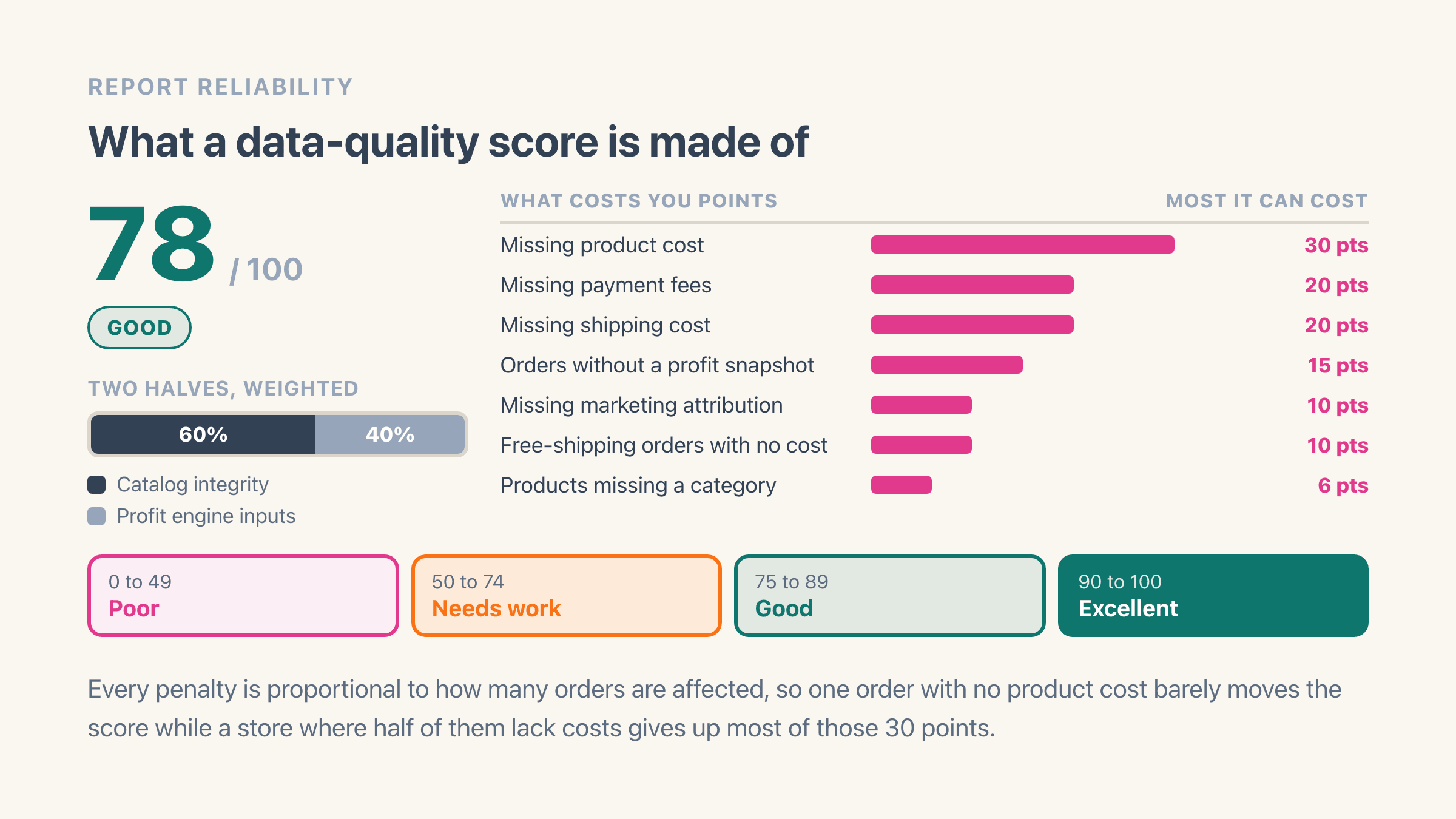
Easy Profit Calculator concentrates on the accuracy of the profit number itself. Every order carries its full cost stack - product cost, the exact payment fee for that gateway and card type, shipping, returns, taxes and attributed ad spend - and every cost is labelled with its source, from exact to estimated. A data-quality score points at the products and orders where data is missing, so a wrong number never hides behind a confident dashboard.
The free plan covers 100 orders a month, double Lifetimely's free tier, and the $19 Pro plan covers 2,000 orders, four times the volume of Lifetimely's $79 plan at a quarter of the price.
- Free for 100 orders a month, then $19 for 2,000
- A source label and confidence flag on every cost
- Break-even ROAS per campaign from your real margins
- Payment-fee rules down to the card type and gateway
- Alerts for below-cost orders and suspicious staff discounts
- Built by a merchant running over $5M a year on Shopify
Where Lifetimely is the better fit
If your business runs on repeat purchase - subscriptions, consumables, anything where customer lifetime value drives the ad budget - Lifetimely's cohorts, CAC payback curves and LTV segmentation are the real thing, and Easy Profit Calculator does not try to match them. Its customer report shows profit per customer, not cohort economics.
Lifetimely also syncs Meta and TikTok ad spend live alongside Google, covers Amazon with its add-on, and pipes its AI agent into Slack. A brand with a team, a media buyer and a subscription model gets real value from all of that.
And if that describes a different shop from yours, three more trackers get the same treatment here: TrueProfit, BeProfit and Sellerboard.
What does it cost you to switch profit trackers mid-year?
An afternoon of setup, and most of your history. The setup is finite and you get it back. The history is the part people are surprised by, because a new app can only start from the order data Shopify is willing to hand it on the day it installs.
Shopify caps that. A newly installed app is served the last 60 days of orders and no more, unless it has been granted extended access to your order history. Everything older is invisible to it until the app has been running long enough to have watched those months happen. Switch in July and you get a tool that knows May and June well; the year-on-year comparison you actually wanted has to wait until next July.
Product costs behave differently again, and worse. The Cost per item value on a variant holds one current amount with no memory of what you paid last spring, and Shopify reports profit only for products that had a cost recorded at the time they were sold. That single box is your whole cost of goods sold as far as Shopify is concerned.
Filling in a blank cost today never repairs last quarter. If you have been running with gaps, the old tool and the new one both start from the same blank, so switching costs you nothing there and fixing the costs is the job either way.
How do you make the switch safely?
There is a cheap way to do this. Move at the start of a month, keep the old tool running for that one month, and put the two profit figures for the same week side by side before you cancel anything. One overlapping subscription is a small price for settling which number is closer to your bank statement, and a week that has already closed is the only fair test, because refunds and carrier invoices land late.
Save what you cannot rebuild before you cancel. Cost tables, supplier price lists, shipping rules and fee rules are the parts that took you a weekend, so keep a spreadsheet copy of them wherever they live now. Order data will refill itself over the following two months without your help. In Easy Profit Calculator, exporting a report as a spreadsheet file sits on the $39 Business plan, so if a portable copy of your numbers matters to you, that is the tier to budget for.
Choose Easy Profit Calculator if
you want accurate profit per order at a fraction of the price - free for 100 orders, $19 for 2,000 - and you care more about trustworthy numbers than cohort analysis.
Choose Lifetimely if
lifetime value, cohorts and CAC payback drive your decisions, you sell on Amazon as well as Shopify, or you want Meta and TikTok spend synced live.